
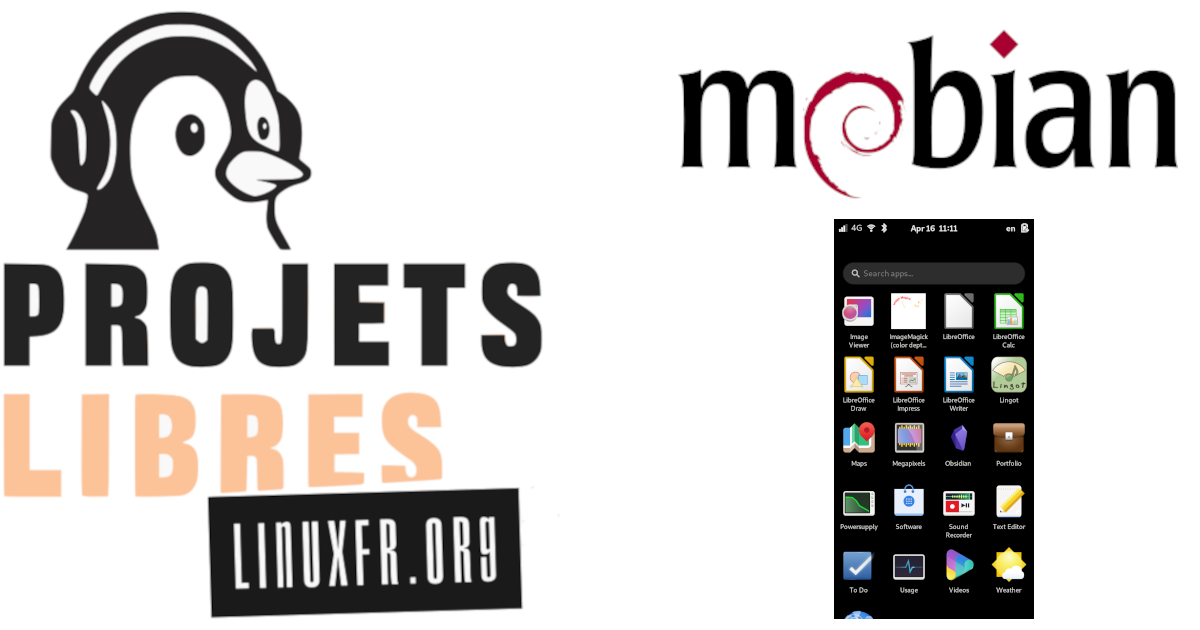
Mobian: Debian in your smartphone
Walid: Welcome to Projets Libres, LinuxFr.org’s podcast, where we talk about free software, open data and the digital commons. I’m Walid Nous and today, it’s a great episode with Arnaud Ferraris who is the founder of Mobian. We’re not going to introduce Arnaud because we did that in detail in the episode on Linux on mobile that I invite you to listen to before listening to that episode, but I suggested to him in the wake of our recording that we take a few minutes to introduce Mobian. What is Mobian? Why does he do it? Who works with him?
So Arnaud, I’m very happy to see you once again on the podcast. Welcome back to you.
Arnaud: thank you Walid.
Presentation and genesis of Mobian
Walid: So can you start by introducing us to Mobian please?
Arnaud: So Mobian is a free project of course, whose goal is ultimately to run Debian on mobile phones or at least on mobile platforms, so phones and tablets.
Walid: Ok so porting the Linux distribution, how did you decide to work on Mobian? How did you get this desire? And when?
Arnaud: So it was done globally at the time of the availability of the first PinePhone. Already, as a smartphone user for a very long time, I had always been frustrated not to be able to use Linux on these machines. I work in IT, I know that a phone is ultimately a computer, and I’ve almost always been forbidden to do what I wanted with these phones.
So I’ve had some experiences with Linux distributions, at least based from far on Linux with Sailfish OS and the first Jolla phone, with Ubuntu Touch on a Nexus 5 a little later. But even in those environments, I felt a bit cramped and constrained by choices that had been made for me at the system level. So there was still this rather old frustration of not being able to use a Linux like I do on my laptop, on my servers, etc.
And at the end of 2019, Pine64 announced the PinePhone. So it uses an Allwinner processor that was already pretty well supported by the embedded software community. So, I admit that there, hope is reborn. I’m pre-ordering the PinePhone which arrives around FOSDEM 2020, just before in fact, two days before, I think. And I actually started playing with it on the plane that took me to Brussels that year. And I’m starting to look at what systems are available. So there was PostmarketOS. There was Manjaro, I think, who was available.
I was also following the saga of Purism’s Librem 5, which also promised a phone that would run a real Linux based on Debian. So I followed all this very closely. And I had the PinePhone in my hands: it’s funny, I install PostmarketOS, very good. But I’ve been using Debian for more than 20 years. And so I want to use Debian. I see that PureOS, so the system that is intended for Librem 5 and based on Debian. I try to install it on the PinePhone by tinkering a little, knowing that my job is to make embedded software under Linux. So I have no trouble compiling a kernel for a specific machine, logging into the console, having the boot process run and analyzing the issues. It’s part of my job, so it’s still an ease that I have at this level. And so I made a kernel for the PinePhone, I tried to install PureOS, realize that they use a fairly old Debian, that it’s not quite adapted to what I would like. Anyway I think ok I’m going to create a Debian image for the PinePhone myself and install Phosh on it, so one of the desktop environments and start playing with it.
Finally that’s how it started, behind it I posted on the Pine64 forum to say “hey if you want I have Debian packages for that, an image that’s ready, I put it on a server to go and see” and finally quite surprisingly for me it interested other people. So there are some who installed it, who said to themselves “Oh, that’s great, that’s exactly what I wanted”, others who came to send me private messages to tell me “this is exactly the kind of project I was waiting for, I want to help, what can I do?” And that’s finally how it started.
Walid: What we didn’t necessarily say in the previous episode is that you actually had an experience with several of the other mobile Linux operating systems that were available. You decided to do Mobian. What is your relationship with Debian? It’s a port that is not at all official. Were you already a Debian contributor?
Arnaud: No, not at all. In fact, I had been a Debian user for a very long time, since the Woody version, so Debian 3. But I had never contributed to Debian. I have contributed to other open source projects, in a way, let’s say, one-off, but I had never embarked on a long-term contribution, and above all, I had never imagined that I could contribute anything to the Debian project. Even if I still wanted to participate, because all my IT is based on it, I love this distribution and how it works, I think well, it would be nice to be able to do something anyway. And so eventually, I started Mobian as a simple Debian user in the first place. I just wanted to do my thing and that’s it, it was stupidly responding in a selfish way to a personal need. The fact that people were interested, that suddenly, behind it, I also built relationships with Debian developers who were interested in Linux on mobile, meant that, quite quickly, I became a Debian maintainer, the first official level of participation in the Debian project. And after two years and being an integral part of the Debian on mobile team and now a number of packages, I applied to be a Debian developer and I am currently since 2023 I think if I say no nonsense.
Walid: When you come to the Debian forum or a discussion channel, you say “hello, I made a port of Debian, on mobile and everything” how does it work? And now, you’re a maintainer but basically, you were a maintainer of specific packages for Mobian?
Mobian’s relationship to the Debian project
Arnaud: Yes, actually, what happened is that I quickly had contact with the developers of Purism, in particular Guido Günther and Sebastian Krzyszkowiak, who are the main developers, basically, of the Phosh graphical environment. One of the things I had in mind, anyway, for my personal use was to package Phosh and its dependencies for a modern version of Debian. So I quickly got in touch with Guido in particular, who had already been a Debian developer for a while but didn’t have the time, at the time, with the time his work for Purism, to take care of properly packaging these softwares.
So I know more exactly how the contact went, if it was me or him who contacted the other. In short, the fact remains that he put my foot in the stirrup in a way. He guided me, he helped me to package Phosh first and upload it, to upload the first versions to the Debian archive. So both in terms of mentoring, let’s say, coaching and since only official Debian developers have the right to upload packages, he sponsored my uploads and integrated me into the Debian on mobile team which was really embryonic at the time.
Walid: Are these people you meet for example at trade fairs like FOSDEM or elsewhere? Who are you talking to? Is it mostly online?
Arnaud: It depends on the person. There are indeed some that I meet regularly at FOSDEM or at other conferences. For example, DebConf last year, which is Debian’s annual conference, which was held in Brest, there were a number of mobile contributors from all over Europe, with whom I was able to talk for once in real life. And others, with whom I only interact online, either because we have never had the opportunity to cross paths at an event until now, or because they live on the other side of the world, in the United States, Australia or India, and the trips are a little more substantial, let’s say.
The Mobian Community
Walid: Do you think that the community of people who gravitate around Mobian is a small average community for them? How do you estimate it?
Arnaud: Yes, Mobian is really a small community, in the sense that there are between five and ten regular contributors to Mobian. That being said, I talk about Mobian as an independent project. That being said, we also have, for the most part, Mobian contributors and also other contributors, a participation in the team I already mentioned, Debian on Mobile, which is a Debian team that only works on the official Debian packages and therefore the debian packaging that are available to any Debian user. And now we’re going to work on packaging mobile-relevant software in Debian directly.
So in the end, Mobian is really a very small overlay to Debian, which is now mainly oriented towards hardware support. But everything that is more generic and everything that is app, graphic environment, etc. this is a work that is done directly in Debian. As a result, the people who take care of it, I don’t necessarily include them as a Mobian contributor.
The goal for Mobian
Walid: Apart from your own use of Mobian, what is the purpose of Mobian? You’re talking about the fact that here, it’s pretty much based on the hardware support side, etc. Do you have any particular goals for Mobian? Do you think it’s a project that can become not as big, for example, as PostmarketOS? How do you see things a little bit on that, what?
Arnaud: Very clearly my ultimate goal is that Mobian is no longer necessary. That’s also why from the beginning I pushed contributors to contribute first to Debian when it was relevant rather than to Mobian directly and why I continue to have this philosophy and that globally all contributors have this vision at the moment. That is to say, everything that is in Mobian is what does not belong in Debian directly. and that’s why we’re mainly working on the hardware support, because in the end the other aspects of mobile use, we’ve managed to make Debian packages generic enough to be relevant for the distribution itself. And so we try to become as irrelevant as possible over time. So what I hope is that eventually we’ll have enough hardware support in the Mainline Linux kernel for enough phones, so that we don’t have to deal with that in a side project that’s Mobian, and that eventually Mobian will eventually disappear and maybe just be a disk image generation service for this or that machine, but nothing more.
Walid: Okay, maybe I’m going to say something stupid, but is that kind of what Fedora is trying to do with Fedora Mobile or not?
Arnaud: So I don’t know that much about the Fedora Mobile devs.
How do I test Mobian?
Walid: It’s all new, they announced it not too long ago.
If there are people who are interested, for example I am interested in testing Mobian, what do you advise me? First, one, where can I see the supported phone list? And two, if I can’t stand it and I have the opportunity to go to a classified ads or refurbished site, what do I buy as a phone? What do you recommend?
Arnaud: So, first of all, in terms of information, we have a site, in quotation marks, which is a simple web page at the address mobian.org, where we have links to the Wiki, which is hosted by the Debian Wiki. The GitLab group, so the same on the Debian instance which is Salsa, and our Matrix channel. And in fact, that’s going to be the starting point for gathering information about Mobian. The wiki allows access to pages, both for developers and for users, with a category that will be “Supported devices“. So on the other hand all the information is mainly in English. If there are translators who would like to make French versions of these pages, they are of course welcome. But the first obstacle to overcome will be the language barrier. That being said, on the Debian/Mobian Wiki, we will have the list of supported phones. And so in terms of the machines that I would recommend, there are a number of them depending on the expectations in terms of performance and budget. For example, we have the original PinePhone which is very inefficient but quite cheap. The PinePhone Pro which is unfortunately more manufactured, which is much more efficient but which is not necessarily as pleasant in the hand as other phones. And the Android machine side that we will find more easily on the second-hand market will be the OnePlus 6 and 6T and the Pixel 3A or 3A XL. In short, these are the two families of machines that are the best supported at the moment and that are to be preferred for a user who would like to test Mobian.
Walid: I found the 6T for less than 100 euros on leboncoin. Well under 100 euros on leboncoin. So it’s a phone that is quite affordable and is still quite powerful and has a great experience under Linux.
Arnaud: Absolutely. And both the OnePlus 6 and the Pixel 3 are phones that were sold very well at the time of their release and therefore are still quite easy to find on second-hand sites even refurbished with a warranty, etc.
Collaboration with other projects in the mobile ecosystem
Walid: Last question, you talked about the fact that you collaborate with the Debian people, you are part of Debian Mobile, you collaborate with the Purism people. Without Mobian, it allowed you to collaborate with what other projects in the ecosystem?
Arnaud: Mainly PostmarketOS, in the end. The advantage of this project is that they have a large community of both users and developers, especially developers who have skills in kernel [Linux] development. So in the end, almost all the kernels that we use for the machines supported under Mobian are developed by people who are part of them or affiliated with PostmarketOS as a general rule. So we have a lot of interactions with them, especially through the fact that we have visions that align quite well with the need to do upstream development so that it is sustainable, so that it can be used by everyone. On the fact that we try to have generic solutions rather than hacks by device. This has been the case, especially in terms of audio management for phone calls, where there have been huge synergies on this point in particular, a lot of interaction with PostmarketOS but also a lot of factual contribution or simply exchanges with other projects, especially application developers. So as far as I’m concerned, Phosh and GNOME users, I’ve rather interacted with application developers in that ecosystem and contributed to different audio players, contact managers, calendars etc. But in the end, the ecosystem is so large that you find yourself quite quickly exchanging and interacting with a whole host of other people for various needs.
Walid: ok, thank you Arnaud for this little presentation of Mobian. Again, if you want to know more, we talked a lot more in a previous episode together. So, I invite all listeners to refer you to this episode. Thank you for your time. Thank you for coming to present Mobian. It’s very nice. I haven’t tested it yet. I hope to have the opportunity to do so at some point. And then, well, we’ll see you for other episodes on Linux on mobile later for listeners. I still have a lot of ideas on the matter. Thank you Arnaud, see you soon.
Arnaud: thank you Walid and thank you for this series of very interesting podcasts and I look forward to it.
Episode production
- Remote recording on April 13, 2026
- Basis: Walid Nouh
- Editing: Walid Nouh
- Transcript: Walid Nouh
This interview has been automatically translated from the original language into English.
License
This podcast is released under the CC BY-SA 4.0 license or later