
Discover the OSM France association!
Walid: Hello and welcome to Projets Libres, the LinuxFR podcast that talks about free software, open data and digital commons. I’m Walid Nouh and today I’m at the State of the Map 2026. I invite you to listen to the presentation episode of the event and I’m with members of the Board of Directors of the OpenStreetMap France association who will tell us about the association, who they are, what the association does and its actions today.
Presentation of the guests
Walid: So I’ll let you introduce yourselves one after the other in a brief way.
Enzo: Hello Walid, Enzo Brière, member of the association for two years now. I’ve been an OpenStreetMap contributor for four years, and also Panoramax, because the ecosystem is a bit big.
In the association, I try to animate the network, local groups, among others. Professionally, I am a GIS project manager in a company that makes photos and databases: so again Panoramax and OpenStreetMap. I combine business with pleasure.
Tony: Tony Emery. I’ve been with the association since the beginning of 2011 and on the Board of Directors since 2012. I’m a local civil servant, I work for the Montpellier metropolis. So at the beginning, when I was working on other local authorities, including Orange, we contributed a lot to OSM. We took the gamble of putting all the community’s data in OSM. In the metropolis, I’m more in the opposite, i.e. how to build precise data to make it available to contributors.
Donat: Hello Walid, it’s Donat. I’ve been with the OpenStreetMap France association since 2016 and on the Board of Directors since 2016 as well. I’m in charge of the association’s finances. And on OpenStreetMap projects, I mainly take care of several small hobbies, including road names, churches, fire stations. And professionally, I’m a human resources assistant.
Walid: Okay, ok. And you, Thibault?
Thibaut: Hello Walid, it’s Thibaut Maïto. I’ve been a contributor since 2018. I joined the association in 2024 and this is my first year. I was elected as a member of the board of directors since June, so I’m very new here. I take care of all the sponsorship, support, patron of the association. And my job is far from that environment: I’m an electronics engineer, so it has nothing to do with that. But electronics, computer science and the digital commons are a world that comes together quite a bit. So that’s why I joined OpenStreetMap.
Presentation of OSM France
Walid: Very good, super interesting. You have quite different profiles. For those who would like to know more about the OSM project, I refer you to the interview we did with Christian Quest to present the project, in which we also talked a little bit about the association. But I’d like one of you to explain to me again what the OpenStreetMap France association is and what your main missions are. Who wants to stick to it?
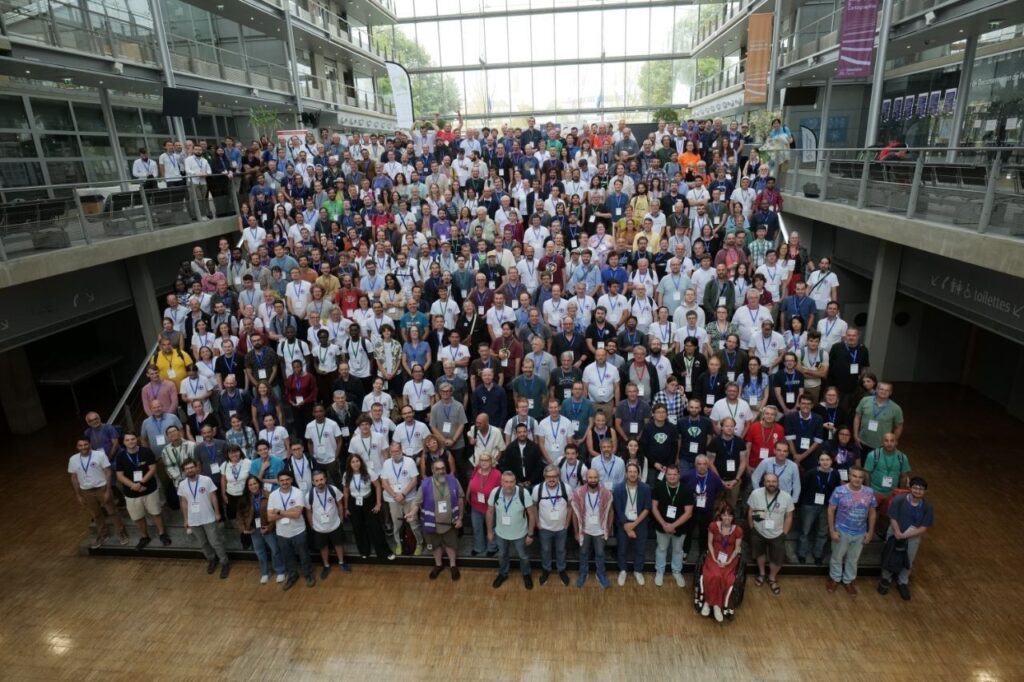
Donat: The OpenStreetMap France association is there to support the community and to promote the project. A bit like Wikimedia, we have more or less the same ways of operating. That is to say that the OpenStreetMap foundation takes care of everything that is really data, free data, OpenStreetMap data, and some servers, the license as well. And the OpenStreetMap France association is more in charge of encouraging contributions, providing services so that the community can contribute more easily, organizing the State of the Map in France, and supporting local groups.
Walid: So, organizing the State of the Map, that is to say the French edition that takes place every year, is that right? Organized by the association?
Donat: Yes, absolutely. Every year, we organize a gathering of the French community to discuss projects, to move projects forward, to discuss, to exchange, because there are many things in the ecosystem. We need to come together because we are all remote. And it’s true that remote contribution does not replace real meetings between contributors and that’s where we really move forward the best to move the project forward.
Walid: So the FR is France? It’s an association under the law of 1901, it’s not a French-speaking association, is it?
Tony: Francophone, yes, we can effectively open the debate to all French-speaking countries. As Donat said, indeed, one of our missions is to try to articulate, to pool and to make people discover local groups, everything happens with the contributors.
We are used to saying that the OSM project is about data and people, but that the most important thing is still people. Because if we delete data, there will always be people to refresh it. If we delete people, there will be no more data. The important thing for us is really that part, to bring together people, projects, and to make sure that we put a little oil in the wheels and facilitate these projects, which are contributors’ projects.
The actions carried out by the association
Walid: And so, among the projects, what are the major projects, the major actions that will be carried out within the association?
Tony: There have been several in the story. It’s absolutely not linear at all. But in fact, as I said earlier, it’s really carried by the contributors. And we’re really there in terms of support. After that, what can we say? There are quite a few things.
Enzo: Afterwards, maybe we should come back to the difficulties of the association. Because we are all volunteers. It’s great, but suddenly, sometimes, there are certain actions that we would like to implement and that require resources. You have to manage to have a little money anyway. Especially for all the advocacy.
We have something that’s incredible, but then we have to manage to spread it and share it with everyone. And it’s something that’s quite difficult actually. It takes a lot of time and energy and that, OpenStreetMap contributors, that’s not necessarily their thing. They like to contribute, they like to update the map.
But then, there are some who are a little more motivated and who will communicate with their municipality or a little more. We don’t yet have any really advocacy on a national or even a little more regional scale. We have very committed people who infiltrate, if I may say so, the communities and who suddenly make the project grow like that. But there is still perhaps a broader advocacy to be made to public and private actors. And also potentially to try to recruit new members, since we also work thanks to them.
Walid: How many of you are in terms of members? Currently,
Donat: We are about a hundred members. It’s true that we didn’t make it a priority objective because for us, the important thing is the community. But like any association, you still have to have members. And so, it’s true that with Thibaut, we’re going to work a little bit on this to increase the number of members, of contributors who become members to support the association and also to develop more institutional memberships so that we can have people who feel a little more involved in this.
And to join Enzo a little bit, the difficulties we have are that as we work a lot in a commercial ecosystem, with local authorities, with commercial services such as Michelin or TomTom, they are often professionals. So they work during the day and then we have time available in the evening. So it’s true that it’s very complicated to have slots available. For example, we’re part of the plenary assembly of the National Council for Geographic Information. And it’s true that we don’t necessarily have all the time. You might as well go to these meetings to carry the voice of OpenStreetMap in general.
Walid: On the fact of trying to recruit new members, you were talking about institutional members. So a local authority could join the association?
Thibaut: Yes, exactly. So, each community, company, has the opportunity to join the association, to help us, first of all financially, but also to be a key player in the association’s project. So, that’s why we are looking for this kind of personalities, characters and public actors, above all. It’s a double challenge.
Of course, there is the financial side that is necessary for any association and which is the sinews of war, but also, it also gives visibility, to show them that, thanks to their support, behind it, they have, I’m not going to say a service, but a possibility of having something that is very powerful, that is supported by their citizens too, especially at the state level, which shows them the power of use of this data. To contribute to OpenStreetMap, you don’t have to be a member of local associations or groups. You can do this easily by registering with very simple information, such as simply a pseudonym.
You don’t need to have a complete identity. But it’s true that we’d like to find people who want to join, so support the association, find public and private actors to do it. We have a few. We talked about TomTom and Michelin who… use OpenStreetMap data which also helps us keep this community, because community, as Tony said, is the sinews of war. Without community, there is no data.
If the data no longer exists, the community rebuilds it. So it’s true that it’s something that is very important for us and that it’s one of the actions that we’re going to carry out for the next few years, to have institutional players and who will, as a result, also give visual power to more and more players and that’s what we’re looking for in the coming days, months of the association.
Walid: We were talking about advocacy, is that one of the things you would like to develop, advocacy? Do more advocacy?
Tony: More action to make open data prevail. In our statutes, that’s it, it’s promoting the OpenStreetMap project, open data in general and open source. And so there you have it, we really need to go and do a little missionary in local authorities, with companies, to remind people of the rule and the law. And then try to facilitate a little bit this opening of data which is essential in our opinion.
Enzo: Because we have the community that creates data, but also for that we need basemaps, for example. So that’s also why we’re part of the council, why we’re invited to the CNIG, to discuss with them since they try to make certain data issues available, such as the PCRS (Simplified Street Body Plan), which allows us to have very high resolution imagery at 5 cm. And that’s something that, for OpenStreetMap contributors, is really a fairly substantial support to contribute.
And without this data, it’s still possible, because we have the ortho comic at 20 cm, but it’s less pleasant. And as a result, there are really a lot of things to put in place and to try to recover certain data streams that we don’t necessarily have and that are sometimes a little tricky to recover. But we try to do it anyway.
Walid: Often on the podcast, I ask: do you have any problems as an association? I know that when I interview associations, there are often issues that come up around the renewal of members, diversity, etc. Do you have problems a bit like the others or others that are quite specific? I don’t know who will answer.
Enzo: I think you’re right in the middle of it. How many of us are on the board this year? Maybe there are seven of us? Nine, sorry. Nine men, and we’d like to allow… to have a little more diversity in our decision-making body. But by that, I think it also means a little more diversity in the community, in a broad way. There are a lot of things to put in place.
Walid: In the community, it’s mainly male? What do you know about it?
Tony: We see it through all the State of the Map events that we organize, which don’t only represent the members of the association, but really the contributors. We still have a lot of male profiles in these events. One of the objectives, but one that is not new, is a question that has been recurrent, for a very long time, we have been asking ourselves how can we do to feminize the Board of Directors and the association a little bit. These are problems that have been raised for a very long time, to which we don’t yet have a solution, but we would like to find solutions.
Thibaut: To be part of the electronic part, OpenStreetMap seems very technical, which is completely false, we have to admit it. We see it as a difficulty to map something thinking that it is very technical, etc. So that’s where the difficulty perhaps appears, is that in technical fields and things like that, we have very little female representation. That’s why I want to demystify this with OpenStreetMap, is that OpenStreetMap, you don’t need to be an expert to be able to place a point of interest, a new business.
We have tools that are very easy to make. So there you have it, it would be a much more incentive perhaps for the younger generations to… to have this tool, to show it to other people and above all to be able to capture a perhaps more feminine intention, that would be an ideal. After that, it’s up to us to play, we have inclusion groups that are working on this to really make inclusive documentation, not to say that contributors, so we say contributors.
We have language terms that we need to say because it’s true that it’s mixed, we don’t have a technical salary, as I say, but it’s not at all. As a result, anyone can make cartography evolve, can come to the State of the Map.
Moreover, we may also be talking about men and women, but for all people combined, there is no barrier. And we would like this barrier to never exist, and on the contrary, to be able to bring in as many people as possible. So we invite everyone to come and help us, to come without necessarily being a member, without necessarily being on the board of directors. Everyone is welcome, is welcome to help the association at its level, at its level, and we invite them for that.
Walid: Last question before I leave you a final word. Do you see an evolution in terms of the number of contributions? Are there more people contributing, are there fewer? How do you see that?
Donat: Actually, when I arrived in OpenStreetMap in 2015, I think we were at 200 contributors per day in France. So contributors can be foreigners, but in any case they are contributors who contribute on French territory. We are at about 200 and now we are at 500. So in fact it is increasing a lot.
Thibaut: The forum has 750 people, more than 750 people registered on the forum and that’s 7,000 messages per year that are written again on the forum. So we have a great vitality on this forum, which is a very lively vector for us. It’s a tool that is very powerful because that’s where we can talk about any subject. From the presentation of the contributor, the first part is that, it’s to introduce yourself within the community, to say why you want to contribute to OpenStreetMap, we have really varied profiles and we love that.
And above all, it is on this same forum that we can talk about contribution problems, exchange with people, and also announce events that we also organize in the more national sector. But also, this forum is also the same lever, the same tool for local contributors, local groups who can announce their monthly meeting or their monthly meeting. And also, you have a part of the forum open for all the association’s projects and that all contributors can see the evolution of our various projects and associative actions.
Enzo: The link to the forum is forum.opentretmap.fr
Walid: We’re going to leave before… Thank you for taking a little time to present this to us. And just a final word, does anyone want to pass on a message to the listeners of the podcast Projets Libres! ?
Enzo: Just to say that OpenStreetMap is fun. It allows you to meet a lot of people. Incredible. And that it’s a great project that still has a lot of future.
Tony: It’s a project that, since its existence, we don’t need to introduce OSM anymore, at least for users of geographic data. We’ve known all the benefits that OpenStreetMap brings for a very long time. Now, we need people, members, and driving forces to continue this project because the first of us are starting to get a boost. We also need to renew ourselves a little.
So come and join us. Next year, the association will organize this theme again, since this year it’s international, and so every year it’s going to be the local chapter that will organize it. I don’t know if it’s official, but in any case in Rouen it’s official. So next year it will be in Rouen, we don’t have the date yet, but it’s usually in June, just before the holidays. It’s impeccable. Come all and then we welcome you with pleasure.
Walid: Thank you to all four of you. And then for the listeners, see you soon to talk about OpenStreetMap again. I think we’ll talk about it again in the coming months on the podcast. Thank you.
Listen also
- The Federation of OpenStreetMap Professionals in France (FPOSM)
- An introduction to the OpenStreetMap project
Episode production
- On-site recording at the State of the Map on August 30, 2026
- Basis: Walid Nouh
- Editing: Walid Nouh
A big thank you to the OpenStreetMap Professionals Association (FPOSM) for their invitation to the event.
This interview has been automatically translated from the original language into English.
Use of AI
You can consult our AI charter.
Production:
- Noise reduction in Audacity via OpenVino and the DeepNetFilter2 model
- Transcript: whisper-medium
- Transcription Improvement: Kimi K2.6
Publication:
- English translation of social media posts: Mistral-Small 4
- Thumbnail: Claude Design
License
This podcast is released under the CC BY-SA 4.0 license or later