
Behind the scenes of the Capitole du Libre organized in Toulouse since 2011
Walid : Hello and welcome to Projets Libres, LinuxFr.org’s podcast, which talks about free software, open data and the digital commons. I’m Walid Nouh and today, I’m really excited because we’re going to talk about an event that I really like called the Capitole du Libre. It’s not the first time I’ve tried to talk about it, but this time, it’s the right one, so I’m really excited.
I have with me two of the organizers: Lionel Porcheron, who is vice-president of the Toulibre association and in charge of the Capitole du Libre, and Guillaume Gasnier, who is president of Toulibre.
Lionel and Guillaume, welcome to Projets Libres. Nice to have you talk about the Capitole du Libre.
Lionel : hello, Thank you for welcoming us and also delighted to share a little bit of the backstage aspects of the Capitole du Libre.
Guillaume : the famous backstage, thank you for inviting us.
Presentation of the guests
Walid guests: we’ll start, as usual, by introducing you. Guillaume, I give you my hand, can you explain to us who you are and how you came to free software, please?
Guillaume : I discovered Free Software with a version of Slackware and a version of Debian that was supposed to be on CD or floppy disks at the very beginning. Then, I let go a little and I moved from the Paris region to Toulouse, and I discovered a very nice association. That’s where my associative involvement was born and that we set up the Capitole du Libre event.
Walid : Okay, you’re part of Team Slackware. Respect.
Guillaume : Yes, not anymore.
Walid : Lionel, over to you.
Lionel : I started when I was a student. I tried to install Linux, like Guillaume, from CDs, or even floppy disks. I’m sure I got floppy disks from Slackware too, but I don’t think I ever managed to install it.
My first real Linux was a Suse, because that was what worked with my graphics card. It was the time when you tried to install different distributions to have sound and something other than 480 by 240 on your PC. Later, in engineering school, I discovered thanks to the computer club the whole universe beyond the PC, all the services, etc., that you could run with free software, especially free software, and with infinite resources with the beginning of the Internet. It was the door open to no longer limiting your imagination to financial aspects. So, it was great.
Presentation of the Capitole du Libre
Walid : Lionel, what is the Capitole du Libre, its values, its objectives?
Lionel: The Capitole du Libre is an event around free software in general: the commons, free culture, free licenses, everything that revolves around free software. It’s an event that we want to be open to everyone, with all types of audiences.
We will welcome developers ranging from the Linux kernel to developers of the 3D Blender software, users of all these softwares, and neophytes who are there to discover what free software is, the alternatives to the paid system, to GAFAM, and to get started.
Not knowing where to go, they walk through the door of the Capitol to find out. So, we really have all types of audience. I think that the strength of the Capitol is to cover this whole panel, to welcome everyone and to offer conferences for all levels too.
Guillaume : Regarding the existence of the event, I don’t know if we have a precise date, because initially, it was called Ubuntu Party where we did Ubuntu Party installs. The real Capitol of Free Software must have appeared in the years 2013-2014, maybe even before Lionel?
Lionel: The first word Capitole du Libre was 2011.
Guillaume : It doesn’t make us any younger.
Lionel : No… We had been doing Ubuntu Parties since 2008 as a mirror image of what existed in Paris at the time. We were several French-speaking Ubuntu developers from Toulouse, including the president of the Ubuntu-fr association, Christophe Sautier.
Mirroring the Ubuntu Party, at the Cité des sciences de la Villette in Paris, we did the equivalent in Toulouse, which was smaller at the time, but which has grown a lot since then. We wanted to get out of the Ubuntu label and open up to a wider audience.
That’s why we renamed the Ubuntu Party the Capitol of Free Software.
From the first editions of Ubuntu Party, we already had an important Install Party component, but also a conference component, which has been expanded more and more over the years, to become what it is today, with more than 100 conferences, while we were supposed to have 5 or 6 conferences at the first Ubuntu Party.
Walid : where is the event held?
Lionel : The event has been held almost since its inception at ENSEEIHT. An Ubuntu Party was held in Blagnac, but since the second version, it has taken place in downtown Toulouse, in the ENSEEIHT engineering school. There were a few of us in the organization who graduated from this school and had some contacts so that the school welcomed us. And we are happy there!
The Conference Hearing
Walid : Is the audience of the Capitole du Libre more regional, in Occitania, or national? How do you see things?
Lionel : It extends from year to year and is largely regional, especially in terms of visitors. We obviously have regulars among the participants, whether they are contributors, those who run the stands, the speakers, or the visitors. A good half of the regulars, who come from all over France, note the date in the agenda in an almost religious way. And the other half is a rotating base.
There aren’t many events on the subject of free software anymore. There are still the Free Software Days in Lyon (JDLL) and the Capitole. These are the two big French-speaking events around free software. This attracts audiences beyond Occitania.
Guillaume : We’ve had hosted events several times and we’ve hosted Debian, I think it was last year, or two years ago.
Lionel : it was in 2024,
Guillaume : The speakers had a room available over the weekend to animate their conferences around Debian. The feedback was very positive. One year, we also had a person from Brazil, to talk about FreeCAD. Our Belgian friends also intervened to talk about various projects.
The price of the conference
Walid : what is the price of the conference?
Lionel : It is completely free. For organizational and security reasons, it is necessary to pre-register. You can get the ticket for free on the site, which does not require you to leave personal information.
The Toulibre association
Walid: I think we’ll come back to that later. Can you introduce the Toulibre association that is running this event?
Guillaume : The association was created in 2006 and is celebrating its 20th anniversary this year. Originally, it was created because the president, Thomas Pétazzoni, had not found an association for Free Software. Since 2006, the objective has been to promote free culture, free software, through various types of actions: conferences, install-parties or meetings in the region. Between 2006 and 2020 until Covid, there were interventions, conferences organized once a week and install parties every 15 days at the Bellegarde Cultural Centre, in the heart of downtown Toulouse. All these actions have collapsed. In addition, with the Meetup platform, a lot of things have disappeared on our side.
The arrival of Covid didn’t help the volunteers present, fatigue too, because being a volunteer for so long, always doing the same thing, committing yourself for so long, consumes a lot of time and energy. After Covid, we put the actions back in place and, quietly, we try to bring in new faces, especially for the actions around the installation parties.
Walid: Quite a commitment to do so many things over such a long period of time. You’re surprising me that in the end, you can be tired and have a routine.
Guillaume : The Capitole du Libre was the event to keep because it brought together the local and national community and neophytes. The energy we get out of it is important for us, but also for others. It was logical to maintain this event in the French landscape, which allows us to talk about free software and free culture over a weekend at ENSEEIHT.
Walid : And how many members does the association have, approximately?
Guillaume : between 30 and 40 members.
Lionel : We haven’t necessarily done a lot of promotion on this. Many volunteers, especially at the Capitole Libre, are not members. To date, there is no need to be a member to participate in the activities, to benefit from the services of the association, to have your computer installed or anything. We have not particularly fought on this aspect. A large part of the members are historically. There are new members too. However, the objective is not for the association to have as many members as possible. We will not become an association with 2000 members in all cases.
Guillaume : Having a lot of members was never an objective at the origin of the association. We are lucky to be in a school with student clubs. So on the Capitole du Libre, the students of the school come to give us a hand. We also welcome them, it’s a give-and-take.
The genesis of the Capitole du Libre
Walid : You explained that originally, the Ubuntu Parties transformed and that you renamed the event “Capitol of Free Software”. Were there any conferences? Who are the people behind the event? How many people were there?
Lionel: Thomas and Christophe Sautier, the founder of Toulibre and one of the instigators of the Ubuntu-fr association, extended to Toulouse what was done in Paris. I think the idea came from there.
I came more from the Ubuntu-fr part. Originally, I knew Christophe. The small hard core had 4-5 people on the Toulibre side with Thomas, Mélanie, Bruno, Fabien, etc. The conference, at the time, lasted an afternoon and was organized with about fifteen volunteers trying to cast a wider net.
Walid : So at the time, were these Ubuntu Parties local?
Lionel : The first Ubuntu Parties were organized by people from the association. A week before, we were saying to each other “do you have a talk in stock?”. It was the beginning of democratization where Ubuntu was taking up a lot of space. It was a little more resourceful. We didn’t have any stars (it’s the week of Celine Dion’s shows: there is no one yet who queues in front of our speakers’ hotel until 3am).
Today, we welcome speakers who come and are known at the national and even international level, such as Stéphane Bortzmeyer and Jean-Baptiste Kempf from VLC, who are known and recognized beyond our borders.
Walid : You were inspired by the Solutions Linux trade show in Paris. Were there other events then, or was this one that made you decide to do an event in the same vein? Were there other events for which you were travelling?
Lionel : We’ve all always participated in FOSDEM, but the goal was never to copy this model that is so big and very developer-oriented, almost more open source than free software, even if the issue of free software and licenses is also very well represented. This conference is a source of inspiration because it’s so big that everyone goes.
At the time, there was still the Rencontres mondiales du Logiciel Libre (RMLL), which was quite well known and attended in France, but it stopped with COVID. The part of the Capitole du Libre was born from the fact that Toulibre had not been selected for the Rencontres mondiales du logiciel Libre. A lot of things had already been thought out and organized, which led to the transition from the Ubuntu Party to the Capitole Libre.
But here’s the thing, the world meeting of free software, it was something that was still, at that time, quite well-known and quite frequented in France. I think that Covid, I’m not sure that they survived Covid. That’s where it stopped.
Guillaume : The RMLL had to stop a few years before.
Walid : In my list, there is an episode to be made on the RMLL because there are so many things to say. So much has happened and it has also spread that it would be worth retelling the history of this event.
Lionel: It’s very hard to make an event that runs like this. We have the comfort of reusing the same place every year with part of the team that remains the same, unlike the RMLL. This is a huge saving in time and energy for the organization of the event.
Guillaume: I didn’t do ENSEEIHT, so I know that I have benchmarks that I wouldn’t have if we changed the venue every year.
Walid: As a participant, the constant location makes it much easier to organize, whether it’s for booking the hotel or knowing what type of room you’re going to be in. It’s reassuring.
Guillaume: The fact that we kept the same place reassures both the organizers and the participants. So, we’re on a pretty good dynamic for the Capitole du Libre.
Walid : What are the major stages for you since the beginning of the Capitole du Libre? Initially, did you have supporters, for example ENSEEIHT? How has this evolved over time? Have there been any significant dates? From when did the event have a national audience?
Lionel : The big stages are marked by the increase in the duration of the event: going from Saturday afternoon to the whole day from 11 a.m. to 6 p.m., and then from Saturday all day to Saturday and Sunday from 10 a.m. to 6 p.m. It was done quite quickly, from 2011 for the day on Saturday, then from 2013 – 2014 over two days.
Guillaume : I think that there was also a structuring when nuclei were formed to go and find speakers at the national level and to think about bringing them in and that, potentially, we would take care of their tickets and accommodation. One thing leading to another, the dynamic of looking for partners was born to be able to pay for these trips, these hotel expenses and then, year after year, to manage to grow and reach the ideal size.
Lionel : Apart from the big changes in format, the conference was more of a slow evolution than a revolution, even on the teams. When Thomas handed over, it was one of the highlights of the association, but did not impact the visitors. The members of the hard core took over. There are a lot of things that are done rather smoothly and in transition.
Walid: If you’re coming from far away, you might as well make the trip profitable and come for the whole weekend.
Lionel: We changed categories the day we went from a local event, which was done in the afternoon or during the day with acquaintances, to a two-day event. We were able to attract more people, whether visitors or speakers. That’s what made the Capitole du Libre grow at the national level. We changed dimension at that time.
The event has always benefited from support, especially in terms of funding. Apart from last year, we have always had the support of the Toulouse city hall, which has contributed to the Capitole.
The companies active in free software, whether they are small publishers, consulting companies that make up the economic fabric of Toulouse have always accompanied us and always followed us. Some sponsors have been there since the first edition.
So, we are also lucky to have both visitors and loyal speakers, but also loyal support over the years. Currently in all the development conferences in France, it is clear that it is a bit complicated. Many are cancelled due to budget restrictions. We are doing quite well for 2026, the sponsors are very loyal.
Walid : What I find really interesting in the Capitole du Libre, a bit like the JDLL, is the mix between the free software side (with discussions on ethics, values, etc.) and discussions with conferences, rather business, around topics of companies, industry, etc. ; and above all, in-depth discussions, subjects, really free software and not necessarily Open source. However, there are few conferences of this type.
Lionel : One of the aspects that I find interesting is that there are people who come, especially on the younger ones, on aspects that are very technical and who also leave with broader considerations. On “yes, I use free software on a daily basis, but what does that imply?”
We talk about free software, but we have a whole section on what privacy is, respect for privacy, these notions. Everyone makes their own choices.
We can talk about it later in the communication part: we have a lot of paradoxes in relation to our convictions about communication, but it’s good to be confronted with them with full knowledge of the facts. You can post stuff on Facebook, but you know what it implies, what it means.
And I think it’s good to address all these subjects because there are people who come and discover subjects that they hadn’t thought of. By coming to the Capitol, it also opens up perspectives that they would not have imagined.
COVID and the 2015 attacks
Walid : In preparing this episode, two questions came up on my side: what impact did Covid and the attacks of November 13, 2015 have?
Lionel : The most painful thing, in my opinion, was 2015. The Capitole du Libre was scheduled 7 days after the Bataclan attacks. So, 7 days was too little if we had been on the same weekend, we would probably have held our event in the same circumstances, but we would have taken place a week later.
The Capitole du Libre was scheduled 7 days after the Bataclan attacks. The prefects then imposed on all schools not to maintain public events. The Capitol could not take place in the usual form.
In a spirit of resilience, we tried to mobilize the network and we found third places in order to make what we called the “free bazaar”. Instead of being in a single place, different tracks on themes were dispatched to coworking spaces, to smaller schools that could lend us a room for an afternoon.
So, without the uniqueness and community side that we can have today at the Capitole, this event was able to take place to satisfy the public, especially those who had plane or train tickets. It wasn’t easy because one week before the scheduled event, costs are incurred: caterers, reservations that can’t necessarily be cancelled. And overall, everyone was very, very sporty, whether it was the suppliers or the sponsors. So, in the end, it went very well. But it remains a bit of a painful memory.
After Covid, it was completely different. We missed two editions, 2020 and 2021. The memory of 2015 weighed heavily in the organization of 2020. Organizing the event requires a lot of energy and a lot of time to get there. In 2020, under no circumstances (due to the lockdown, etc.) could it have been held in person. We asked ourselves the question of doing it remotely. However, the Capitole has a community capacity and allows you to meet and exchange with everyone. A camera stream that transcribes a conference seemed to us to be a lot of effort compared to the gains we could make from it.
In 2021, the risk of organising an event that might not take place still seemed too great to us. We certainly should have been under a health pass since the number of visitors exceeded the gauges, which, in the free software community, was not unanimous. So, the reflection was to know if we were organising the event for half of the visitors, the other half risking not coming because of the health pass. We skipped again that year to come back for good in 2022.
Walid : I don’t know if you have anything to add, Guillaume.
Guillaume : In 2022, everyone was present because it was the return of the Capitole du Libre in the format we knew. We tell ourselves afterwards that these difficult decisions to cancel two years in a row were the right ones because we all met on a weekend in November and we were able to share and discuss again as before.
Walid : In one of the previous interviews, Anne, the organizer of Kernel Recipes, said that doing it remotely made little sense because the conference is about people having informal exchanges.
The volunteers who work on the event
Walid: Organizing such an event with a lot of conferences, a lot of visitors, where, in addition, everything is filmed, it’s really good. Indeed, conferences are really important sources to prepare my interviews.
Let’s talk about volunteer work. Who are the volunteers? How many people does that represent?
Lionel: Different nuclei of volunteers will be organized throughout the year. A hard core of 7-8 people works almost all year round on the Capitol.
After the event, at the end of the year, we need to digest, to do a certain number of things: photos, videos, producing reports, etc. From the beginning of the year, we start to ask ourselves what we want to do for the next edition and the hard core of 7-8 people, who make up our first circle, starts to work on it quietly.
In addition, the very long-time volunteers will be called upon during the year, when we want additional opinions.
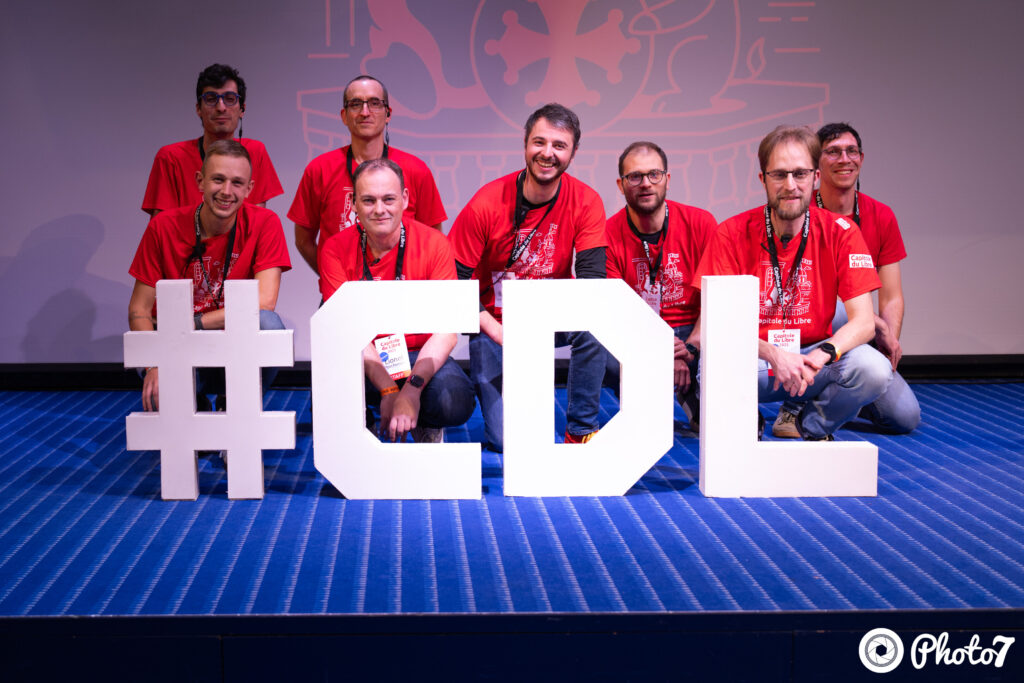
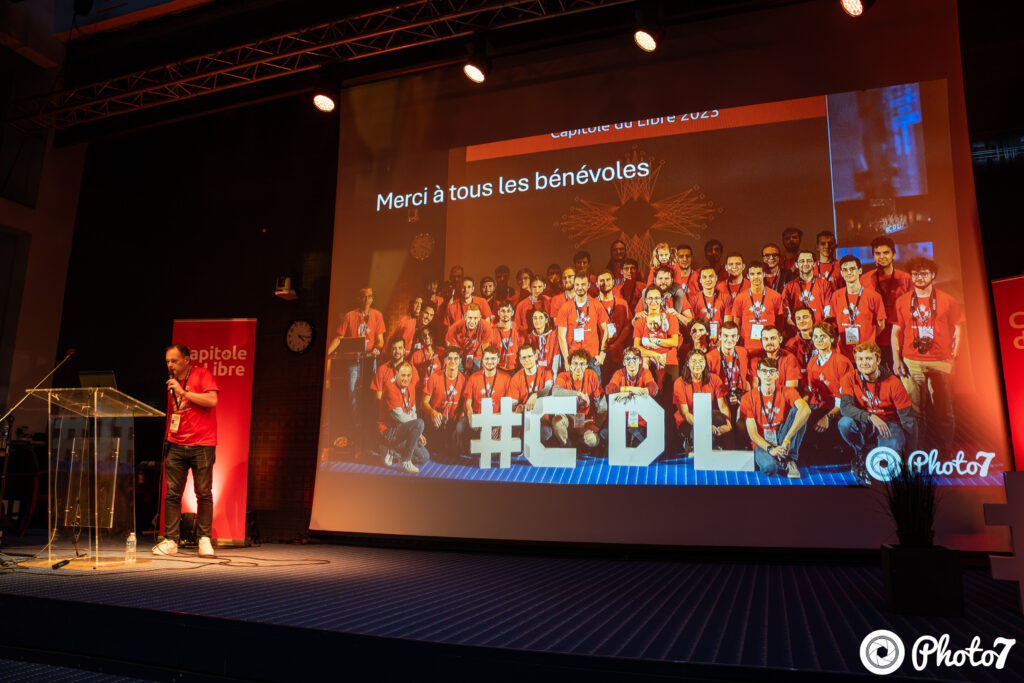
The bulk of the troops will be mobilized over the weekend. The weekend starts for us on Friday. Some of the volunteers are part of the association or are long-time regulars. But most of the volunteers come from the ENSEEIHT clubs because the technical clubs are used to participating in the Capitole and know what they have to do during the event.
The video recording, which is a huge task, is done by the video club. During this weekend, the students will be able to be introduced to their technical club quite easily. An animation club will take care of the sound system, in particular capturing the sound and bringing it back to the cameras and managing the lighting aspect, especially in the large amphitheater. They manage to do nice things on the weekend. The photo club takes care of the photos and the computer club helps us with the whole Install party part.
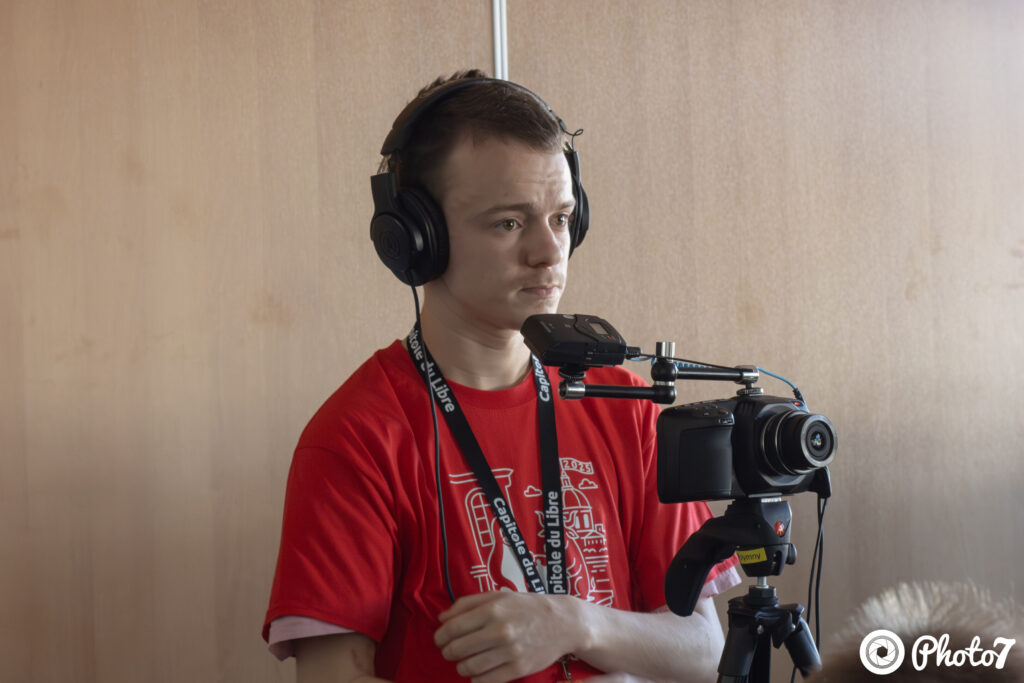
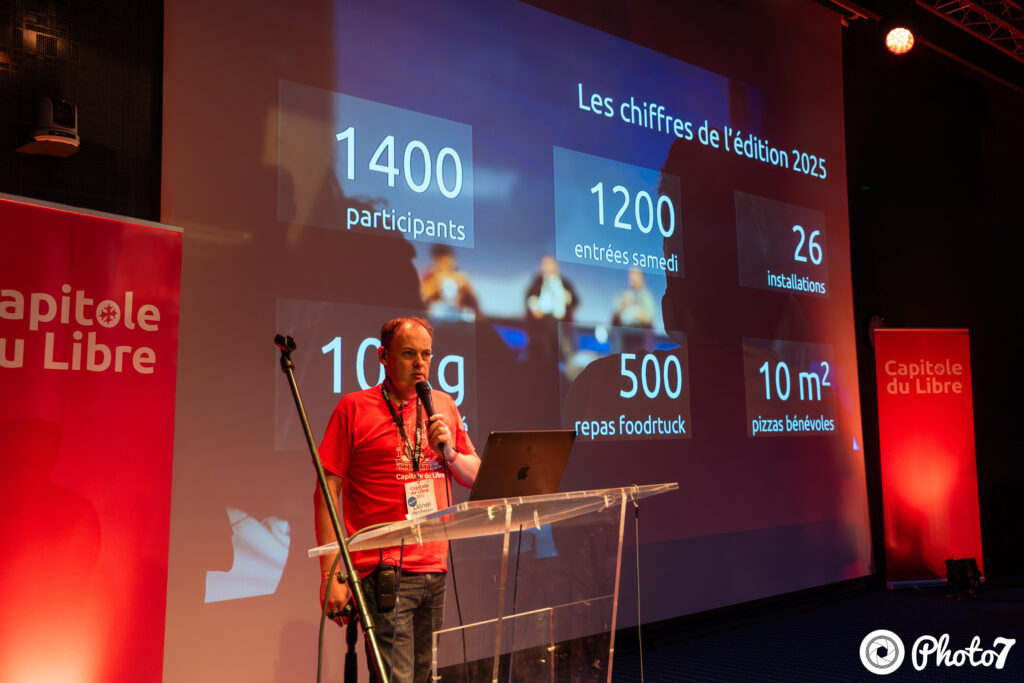
120-130 volunteers participate in the event. It’s also a challenge to make sure that we have people on all the stations. I don’t know if I should say this on a public podcast but what’s magical is that people come back year after year, including on volunteer positions. In practice, volunteers know what they have to do. And somehow, you become a conductor on the weekend: you’re there to set music, and everyone knows how to play the instrument better than you know how to play it.
Walid : Guillaume, do you want to add something?
Guillaume : For the past few editions, on Saturday mornings, we’ve been wondering if it’s going to go well. And then, the older ones will pass on the elements to the new volunteers. In the end, it works so well that it wouldn’t make sense to change locations with these technical clubs. That’s one of the aspects that makes the Capitole du Libre what it is today.
Walid : Is it also a way to spread free culture within ENSEEIHT?
Lionel : Yes. It ties in with the aspect mentioned earlier. Most of these students come here for technical purposes. That’s what interests them, especially those who are part of the video store. These students use Blender a lot today because they discovered it at the Capitole du Libre. But beyond that, it opened their eyes to a lot of things that they weren’t aware of, or that they didn’t necessarily have an appetite for, at least, that they hadn’t been confronted with.
I think these students know about free software because the Capitole du Libre takes place in their school and the fact that they were volunteers allowed them to come to the event.
Professional and associative stands
Walid : Let’s talk about the stands. There is a whole set of stands, whether professional or associative, and the place is really nice and welcoming. Do you want to say a few words about it?
Guillaume : One of the aspects of the Capitole du Libre is to have an associative village, not to mention the professional stands on the ground floor. There are around thirty stands with lots of things, whether hardware or software, where people present their projects.
The big French associations Framasoft and APRIL have been present since almost the beginning. It’s where people can come and exchange. And that’s what makes one of the very interesting aspects of this weekend with a moment of sharing and exchange between people who sometimes discover hardware, software, a philosophy totally different from the one we will find elsewhere.
The financing of the event
Walid: You have loyal sponsors. Do you have a lot of sponsors? Are there different levels of sponsorship?
Lionel: We have four levels of sponsorship, from bronze to platinum, from a few hundred to a few thousand euros. The sponsorship brochure is public. The first three levels have quite small amounts.
The first amounts are a contribution to associate with the Capitole du Libre and support it. We communicate about the participation of these sponsors, but they don’t benefit from any particular compensation, nor a stand during the event, whereas today, at the highest level, the stands of our platinum sponsors are directly in the hall. These are actors who contribute to free software and who are able to talk about it.
We have about fifteen sponsors at all levels with four platinum sponsors. Here too, we have sponsors who are rather loyal.
For us, it is in the genes that the Capitole Libre remains a free event. As a result, we are now based on three pillars: private sponsors, institutional sponsors and the public. We are lucky to have the support of the town hall, the region and the department, at different levels. In addition, the public buys goodies at the shop.
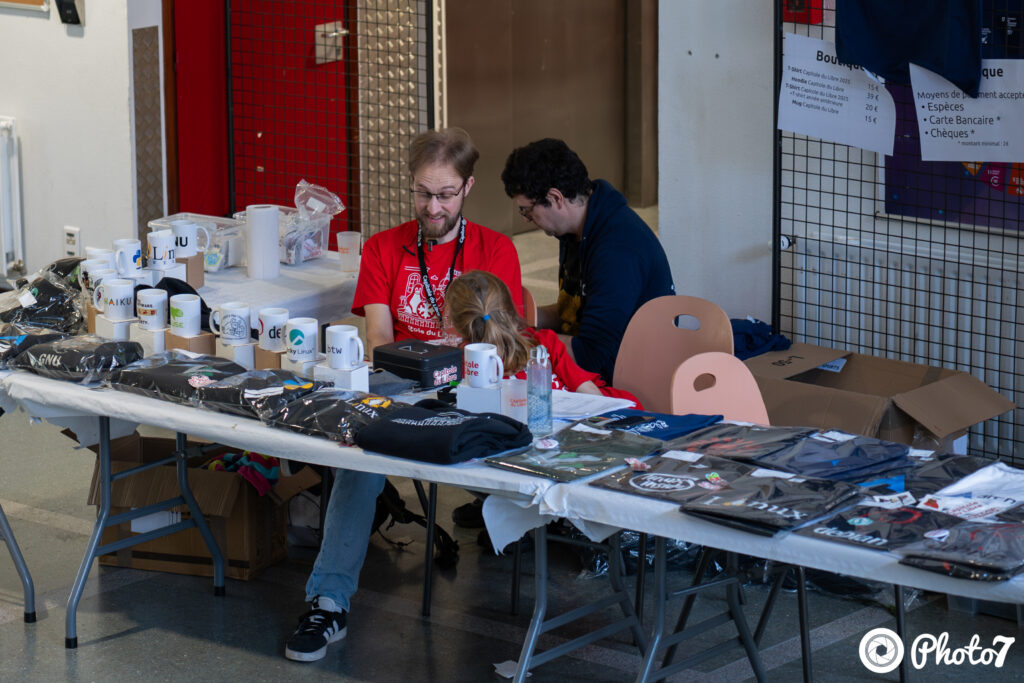
We’ve always had a refreshment bar and last year, we set up solidarity cafés that worked very well, where people could donate: instead of paying 50 cents for their coffee, they could pay 1 euro. It also helps to ensure that the budget is balanced at the end of the event, as our objective is not to free up money.
Walid: You can pay for speakers up to a certain amount, which is not the case in all conferences. Can you give more details?
Lionel: So, we put up a barrier, we try to be fair, but it’s also to prevent there from getting out of hand, voluntary or involuntary, but we give the rules of the game from the beginning. And yes, it’s a part that seems important to us to support the speakers.
The Capitole is an event for which making a program is not easy. There are choices to be made. However, as the proverb indicates, “to choose is to give up”. So, inevitably, there are disappointed people, but the event is also open to first-time speakers and speakers who have not yet participated.
In addition, the event is free unlike some professional conferences, organized for example by the Linux Foundation, whose amount varies between 1000 and 2000 euros, or even more, In this case, everything must be absolutely perfect. This is not the type of event we are looking to do.
To become a speaker, you need a first time, so it’s important for us to give first-time speakers a chance at the Capitole and create a community event where you can talk to the speaker, or discuss the themes he or she is presenting.
Walid: Guillaume, do you want to add something?
Guillaume: I’m on that, Lionel. From the beginning, it was part of what had been planned and put in place to make the speakers feel a little bit at home. We reimburse them for the journey, and possibly the accommodation too. It was, and still is, one of the particularities of Capitole du Libre.
The organization of the program and the selection of conferences
Walid: How does the organization of an edition work? In three participations, I have been several times very surprised by conferences that I was not expecting at all with a “Wow, I’m really happy to have seen this conference” effect, speakers with topics that are really out of the ordinary.
- What are the main steps?
- How do you define the themes and how do you do the programming?
- Do you have a lot of speakers who respond?
- Do you have trouble sorting out?
- Who is on the conference selection committee?
Lionel: The composition of the program and the committee gives rise to a lot of hesitation and exchanges. The invariant is to open a call for participation. To do this, we have a web software [Pretlx] where people submit their proposals. This does not prevent us from posting announcements on social networks, from contacting speakers from previous years’ sessions. On the margins, we contact speakers we have seen at other conferences and whom we would like to have at the Capitol. But in 95% of cases, the speakers come to the Capitol on their own.
Classically, on a conference proposal, they are asked:
- What they’re going to talk about,
- a little bio to know who they are
- why they want to talk to us about this subject.
Then, our program committee is composed of both members of the Capitole organization and sometimes personalities (e.g. April). The idea is that the free software associations that traditionally come to the Capitol can also have a way to choose.
In fact, we have relatively little difference in the votes. Today, we have about a hundred conferences and a dozen workshops, i.e. about 110 to 150 interventions, for 200 proposals. Some are eliminated because:
- that there are speakers who propose 3 or 4 conferences. However, we have limited to 2 interventions per person.
- Some proposals are off-topic.
- Speakers cancel their conferences in the meantime.
After that, these conferences are sorted by theme, but also by time slots of availability of the speakers. Indeed, the time slots will impose certain choices.
Walid: Do you define major themes before opening the submissions? Are you the one who organizes the round tables in the large amphitheater or are they submissions from guests who indicate that they want to organize them with such and such a person?
Guillaume: There have been a lot of debates over the years about round tables. Generally, we organized them, so we tried to get the speakers and then we talked to them about it, and then the round table took place.
But it’s always quite complicated to find the subject and the right speakers, because in the end, we’re not going to bring in someone who isn’t there for just this intervention, but rather use in the speakers we have on the edition to do a round table. We haven’t always had very good feedback on some of the round tables, so we’re more and more hesitant to do them. And I think that this year, we won’t really have a round table on this edition.
Walid: And the major themes?
Lionel: They are rather established a posteriori according to the conferences proposed, although we have a list of themes in the call for participation. Today, we try to bring together the conferences once they have all been proposed, rather than imposing a box in which they should fit, especially because as organizers, we also have surprises about the proposals made, and that we want to see at the Capitole.
Walid: An example of a surprise, I was in the hall talking with Sébastien Dinot, who has already been on the podcast. He told me: “Come on, I’m going to see a conference about a person who creates a lace loom, he does it with his community, etc. It must be nice”. And we went to the conference and really, we hallucinated. I wasn’t expecting anything in particular because I hadn’t necessarily seen the subject.
And it was incredible, you say to yourself “I’m glad I came to see this conference on the Nodus Machine and elsewhere maybe I wouldn’t have the opportunity to see this conference”.
Guillaume: We had very positive feedback about this intervention. It’s one of the strengths of the Capitole du Libre to attract speakers who might never have tried their luck, who come and we discover something incredible.
The anecdotes
Walid: Can you give me some anecdotes, some great moments, whether it’s things you’re super proud of, or things that screwed up a bit, what you remember. Finally, do you have anything to share with us?
Lionel: For a long time, we had one incident a year: bike theft, police intervention, scaffolding threatening to collapse. It’s calmed down a bit in recent years. The organization is going well now. For the anecdotes, the public has trouble finding their way around the school, especially the passage between building A and building C, which involves going down and up, or going up and down. There are three ways to get to the two buildings. And when you don’t know it, it’s quite disturbing, the campus is quite big. So, from time to time, people get lost, or go to the wrong rooms, etc.
Walid: Do you have any great moments? Things that you have retained, that you are super proud of?
Lionel: The big moment is for 48 hours, people thanking you for the organization. You leave with an absolutely incredible boost of energy. On the negative side: three years ago, we had criticism of the choice of proposals. We still have regular criticism from people who challenge us, often rightly, on the representativeness of the speakers, where we can easily lack diversity.
It’s a fight that we try to lead and to offer a maximum of chance to speakers. But some don’t come naturally. We try to encourage them, but it’s not easy. And unfortunately, you can receive unpleasant messages about opinions about the speakers’ intervention at the Capitol. You get criticized, it’s part of the game, somewhere.
Walid: I think you’re not the only ones who have a gender diversity problem. Aren’t there enough women who make proposals to the event?
Lionel: Today, about ten women among the 90 speakers in all. We may be in the free software ecosystem, which is far ahead in terms of accepting differences compared to the rest of society, but it lacks diversity.
The fact remains that we have a lot of white men present on Capitol Hill, just like society. But we try to encourage the visit and intervention of women, in particular, as well as all minorities, and to make sure that they are welcome and as welcome as possible at the Capitol.
Guillaume: I think there is a problem with the feeling of illegitimacy. Many women don’t feel legitimate to come and talk about technical topics. For example, according to Sebastien, his female colleagues working on open source projects don’t do it. After encouraging them, two of them finally made their proposal and found the experience super rewarding.
So, today, this problem deserves to have a dedicated volunteer but I don’t know if we would be able to do much better. Despite our efforts, it’s quite complicated.
And I agree with Lionel’s words, for 48 hours, we get together, we discuss, we regain energy. That’s what gives us the desire to continue and start again the following year.
The communication of the Capitole du Libre
Walid: On which network do you communicate? Where will we find the photos and videos?
Lionel: We try to communicate on as many social networks as possible. We think it’s important to avoid being among ourselves. It’s a bit tempting to have a gathering of pure free software players. To do this, we post on LinkedIn, Twitter, Facebook and Instagram. It brings in neophytes to learn about free software. Part of the mission of the Capitole is to introduce people to these issues.
We try to communicate as much as possible on these networks. After that, there are some that are more or less practical for posting.
Some social networks are more convenient for posting than others. As a result, posts are more or less frequent. LinkedIn works quite well, a network through which we have a good audience. Otherwise, we also use Mastodon for pure free software users.
We have Mastodon for pure free software users. The goal is not to force people to go on a social network that they don’t frequent.
The videos are accessible via a PeerTube: videos.capitoledulibre.org and the photos on a gallery hosted on photos.capitoledulibre.org. The links are on the Capitol website.
Walid: And the videos are available soon after the event.
Lionel: It sometimes varies, but we try.
Guillaume: The students are very efficient, sometimes on that side.
In addition, to announce the event each year, Diamond Editions allows us to have a full page on the bi-monthly September-October edition of SysOps Practical.
The 2026 edition
Walid: What can you tell us about this 2026 edition? What can you expect as a participant in this 2026 edition?
Guillaume: You will see a lot of red t-shirts, that is to say all the volunteers busy trying to make sure that the event goes very well and that everything runs like in previous years. We will have a few conferences, around Blender over the weekend.
Like every year:
- The installation party will also be provided by the students
- The associative village will be there with, again this year, about thirty associations present.
Lionel: It’s in continuity. We won’t have a round table this year. The program has been online for a few weeks. The evening conference will be a little original, since the deputy Cyrielle Chatelain, has offered us to present the conclusions of her report on the digital dependencies of the State, in particular to the GAFAMs.
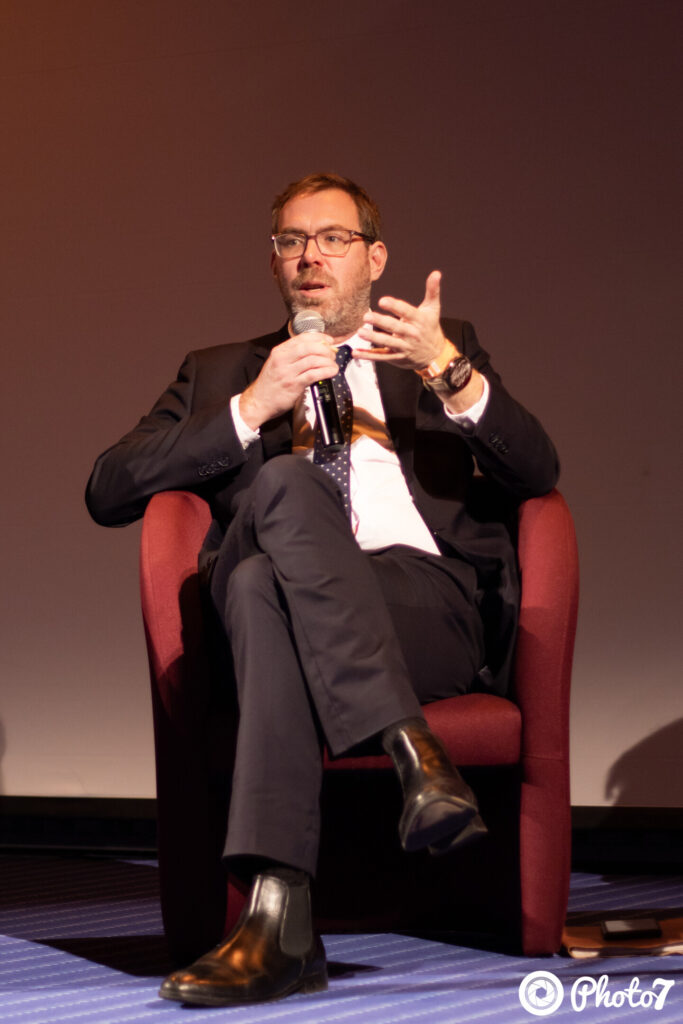
Lionel: These conclusions were drafted following the Parliamentary Commission of Inquiry chaired by Philippe Latombe , who has already come to the Capitol in 2023. This will be followed by a moment of exchange with the public around the conclusions and themes of the moment: the digital dependencies of the State, our companies and individuals.
The unshakeable Stéphane Bortzmeyer will come to talk to us about the Internet and how a global computer network works. These will be the two key moments of the weekend.
But also, many topics around AI will be discussed:
- whether it’s very practical subjects: how do we do it for a local AI? What does it mean?
- Whether it’s on a personal level, or at the level of manufacturers who, for confidentiality reasons, can’t send all the data, e.g. medical, on the Internet to foreign players. What does this mean, how do they adapt to these technological developments?
We also have interventions around art. How does the use of free licenses intervene in the artist’s profession at a time when, with a prompt given to an AI, we can generate art or creations in general?
There are technical conferences on programming software, whether it’s Rust, conferences around DevOps, Kubernetes, etc., like every year. A lot of feedback too, on migrations in free software. So, a very varied, very rich program, more than a hundred conferences. Come and discover it in November.
So, a very varied, very rich program, with more than a hundred conferences. Come discover it in November.
The last word
Walid : Would you like to send a message to the listeners of Projets Libres?
Guillaume: Yes, Toulouse is a beautiful city. And the month of November, generally, is very good. And you have a weekend, in particular mid-November, where you can come and visit an engineering school where an event is taking place, a little bit nice. So don’t hesitate to make your trip at that time and come and see us. It will be a pleasure to welcome you to the Capitole du Libre.
Walid: I can confirm that the weather is good and there are food trucks, you can eat outside, that’s good too. Lionel, your last word?
Lionel: Yes, we’re in the city center, so in addition, it doesn’t prevent you from visiting Toulouse before, after, during the event. Come, I think you’re looking for technical subjects, philosophical topics around free software, to meet ecosystems, contributors, free software users. As long as you want to meet people, to discover things, I think it’s the right place to do it.
Walid: Very well, we’ll stop there. Thank you both very much. For the listeners, if you have the opportunity to come, I invite you to come. It’s really nice, it’s nice to have events like this.
To find the conferences that Raphaël and I will be hosting, go to the Free Projects website on the cover page. There is the link to the conferences on Mobilizon.
Thank you Lionel and Guillaume, see you soon at the Capitole du Libre.
Guillaume: Thank you Walid.
Guillaume: Thank you, Walid. See you soon.
Walid: See you soon.
Episode production
- Remote recording on September 14, 2026
- Plot: Walid Nouh
- Editing: Walid Nouh
- Transcription: Walid Nouh with improvements by Guillaume Gasnier to make the reading more fluid (thanks to him)
Use of AI
You can consult our AI charter.
Production:
- Noise reduction in Audacity via OpenVino and the DeepNetFilter2 model
- Transcript: whisper-medium
- Lionel Porcheron’s voice enhancement: Adobe Enhance Speech
- Transcription Enhancement: GPT-6 Luna
This interview has been automatically translated from the original language into English.
Publication:
- English translation of social media posts: Mistral-Small 4
License
This podcast is released under the CC BY-SA 4.0 license or later